

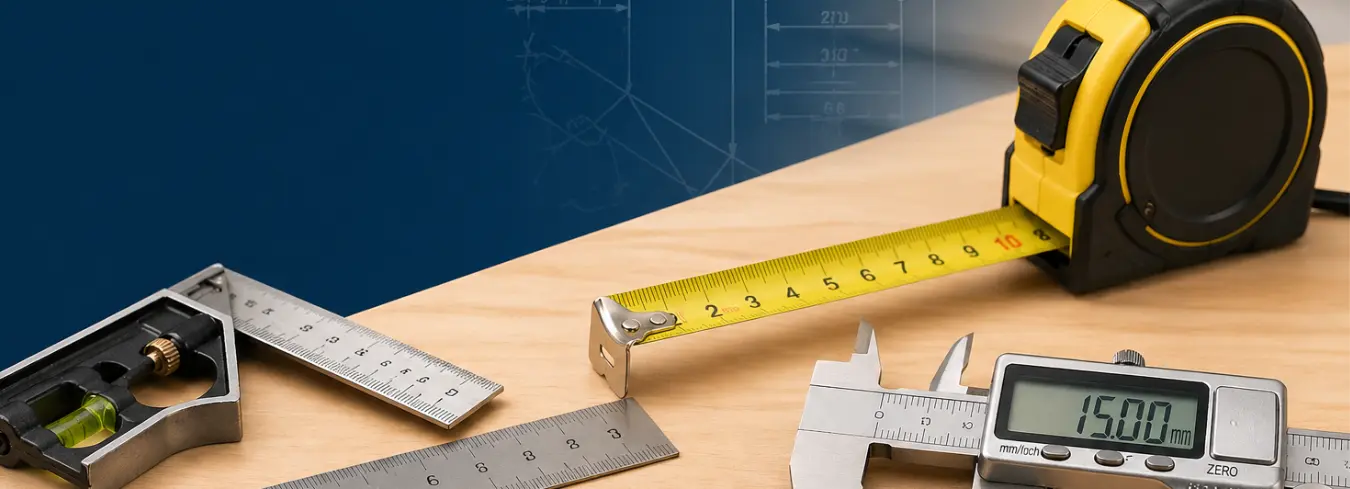
Direct Answer: To select a measuring tool, decide what you need to measure, the range and resolution your tolerance requires, and the working environment. Then choose between manual and digital, and plan for calibration.
Buying on price alone is the quickest way to end up measuring twice.
Most people buy measuring tools based on price, and that single decision causes more headaches than any other mistake. A tool that looks fine on the shelf can give inaccurate readings, fail under pressure or simply not match the job.
Many users only realise this after they start working and notice errors. A little time spent choosing the right tool saves effort, money and frustration later.
This guide covers how to select the right measuring tools. It explains the questions to ask, how common tool types compare and the mistakes to avoid.
How to Choose Measuring Tools: Five Questions to Ask First
Run through these five questions before you buy any measuring equipment:
- What are you measuring? It could be length, depth, diameter, thickness, height or runout, and each one usually needs a different tool.
- What range do you need? Choose an instrument whose range covers your largest part.
- How accurate must it be? For basic work, a small margin of error is fine. For detailed tasks, precision measuring tools matter, because even a tiny difference can affect the result.
- How often and where will you use it? Occasional use does not need anything heavy-duty, but daily use calls for durability and build quality. Dust, heat or moisture can also affect how well an instrument performs over time.
- Who will use it, and how fast? Digital tools make readings quicker and easier, while manual tools remain reliable in rough conditions.
With those answers, the next step is matching the tool type to the job.
Which Measuring Tool for Which Job?
This table shows the typical tool for each measuring job.
| Job | Typical tool |
|---|---|
| Outside, inside and depth dimensions to fine resolution | Caliper (digital, dial or vernier) |
| Very fine outside measurements, such as shaft diameters and thicknesses | Micrometer |
| Checking runout and flatness, or comparing a part to a reference | Dial indicator |
| Internal diameters and bores | Bore gauge |
| Thickness of sheet and materials | Thickness gauge |
| Setting heights and layout on a surface plate | Height gauge |
| Quick checks of length and layout | Steel rule, tape measure or square |
Manual vs Digital Measuring Instruments: Which Should You Choose?
Both types have a place, and the right one depends on speed, conditions and budget.
| Feature | Manual instruments | Digital instruments |
|---|---|---|
| Ease of use | Requires skill to read accurately | Easy to read with an instant display |
| Reading accuracy | Good results with experienced use | Reduces human reading error |
| Power source | No batteries required | Requires batteries |
| Durability | Works well in tough environments | Slightly sensitive to rough conditions |
| Cost | More affordable | Higher upfront cost |
| Speed | Slower reading process | Faster measurements |
| Best for | Long-term reliability and rugged use | Fast-paced work and quality control |
For a deeper comparison, read our guide to digital vs analog measuring instruments.
Get a second opinion on your shortlist
Send us the tools on your shortlist and what you measure, and we will tell you whether they fit the job.
Caliper vs Micrometer: Which One Do You Need?
The two tools overlap, but they are made for different levels of precision.
| Feature | Caliper | Micrometer |
|---|---|---|
| Function | Measures internal, external and depth dimensions | Measures external dimensions with high precision |
| Accuracy level | Good for general use | Very high precision |
| Versatility | Multi-purpose tool | Specialised tool |
| Ease of use | Easier for general tasks | Needs more careful handling |
| Application | Suitable for varied measurements | Best for tight tolerance work |
| Ideal users | General users and workshops | Manufacturing and quality control professionals |
If you are choosing between caliper types, see our comparison of Insize digital and vernier calipers. For micrometer technique, read how to use Mitutoyo micrometers.
Resolution vs Accuracy: Reading the Specification
Resolution is the smallest step an instrument can display. Accuracy is how close its reading is to the true value, and the two are not the same.
A display can show a very fine step without the instrument being that accurate. As a rule, the instrument should resolve a fraction of your tolerance, and its accuracy should be better than the tolerance.
Check the manufacturer’s specification for both figures. Then confirm what calibration the instrument needs to hold its accuracy.
Mistakes to Avoid When Buying Measuring Equipment
These four mistakes cause most poor purchases:
- Buying on price alone: cheap tools often cost more in the long run, through replacements and incorrect readings that cause rework.
- Ignoring calibration: even good measuring equipment loses accuracy over time. Without proper calibration, readings become unreliable and your work suffers.
- Choosing the wrong type of tool: not every tool suits every surface, material or application.
- Overestimating your needs: not every job requires industrial-grade equipment, especially for basic or occasional tasks.
For care after you buy, read how to maintain measuring equipment and the common mistakes when using measuring tools.
Smart and Connected Measuring Tools: What Is Changing
The measuring instruments sector is moving toward smarter, more connected tools. Digital instruments now offer data storage and connectivity, which makes tracking and analysis easier.
Laser-based tools are widely used for distance measurement in construction and large-scale projects. Many precision measuring tools also connect with quality control systems, which reduces manual recording errors.
Insize and Mitutoyo Measuring Instruments at Al Rizq
Al Rizq is an authorised distributor of Insize and an authorised dealer of Mitutoyo in the UAE.
If you already know what you measure, send us the measurement, range and resolution, and we will help you find an instrument that fits.
Start from the measurement, not the catalogue
See the precision measuring instruments we supply, then tell us the measurement, range and resolution you need.
Frequently Asked Questions
What is the difference between measuring tools and precision measuring tools?
Standard measuring tools cover general applications where small variations are acceptable. Precision measuring tools are designed for work that needs very tight accuracy, often down to fractions of a millimetre.
How do I know if I need a digital or manual measuring instrument?
If speed and ease of reading matter most, digital instruments are the better fit. If you work in tough environments or want a battery-free tool, manual instruments are a reliable choice.
What is the difference between resolution and accuracy?
Resolution is the smallest step an instrument displays, and accuracy is how close its reading is to the true value. Check both in the specification.
How often should measuring equipment be calibrated?
Follow the manufacturer’s guidance or your own quality system. Once a year is a common minimum for professional use, and tools used daily in critical work need checking more often.
Are there measuring tools suitable for both construction and manufacturing?
Yes. Laser-based tools suit large construction projects, while calipers and micrometers are common in manufacturing and quality control.
Where can I find a trusted measuring instrument supplier in the UAE?
Al Rizq is an authorised Insize distributor and an authorised Mitutoyo dealer in the UAE. Browse the measuring instruments page, or send us your requirements.