

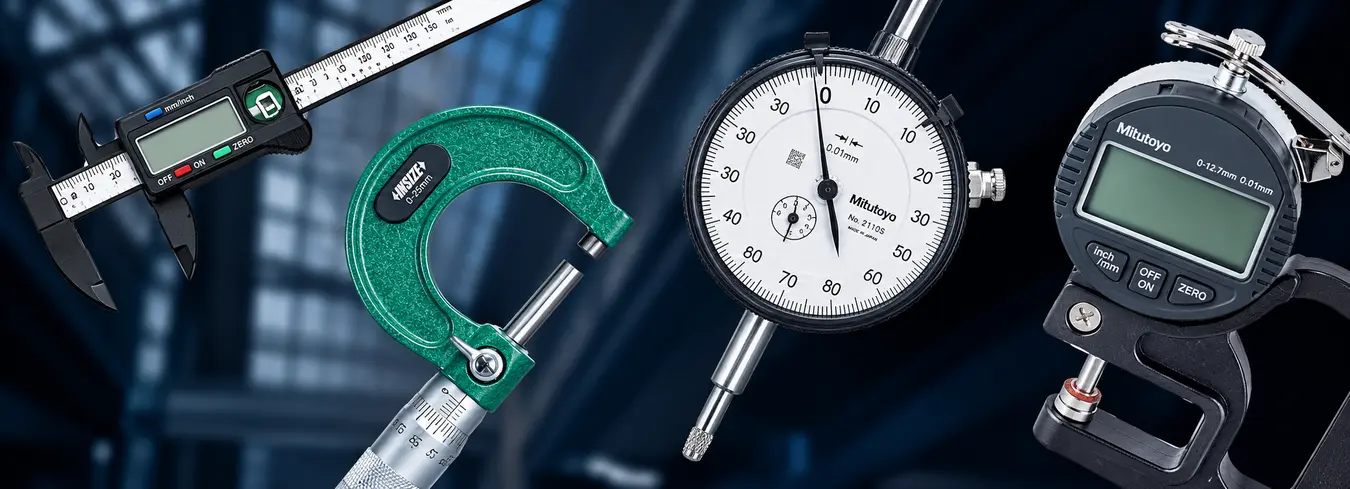
Direct Answer: Digital instruments show a numeric reading that is fast and easy to read, while analog instruments use a pointer or scale and need no battery. Choose digital for quick, repeatable readings and analog for rugged conditions and simple, low-cost use.
The right choice depends less on the display than on where and how you measure.
Accuracy matters in every industry that measures, from engineering and manufacturing to electrical work. Selecting the right measuring instruments affects efficiency and accuracy.
The choice between digital and analog comes up in two common settings: electrical measurement and the workshop. Electrical measurement uses meters and gauges that show voltage, current or pressure, while the workshop uses calipers, micrometers and dial indicators. This guide explains the difference and how to choose in both.
Analog Instruments: Pointer, Scale and Simplicity
Analog instruments measure things like voltage, current, power and energy in a continuous way. They give an output that changes steadily with the input, usually shown by a pointer on a dial or scale.
Many work by electromagnetic induction. A magnet, either permanent or an electromagnet, interacts with the field from a coil carrying current. This moves a pointer across a scale to show the measurement.
Advantages of analog instruments:
- Durability: they have no battery or electronics to fail, which often makes them long-lived, although the mechanism can still be damaged by shock.
- Cost-effective: they are generally cheaper than their digital counterparts.
- Easy to use: there is no software or battery to manage, although analog instruments still need periodic calibration.
- Reliable in rough conditions: many analog instruments cope well with dust, humidity and temperature extremes.
Digital Instruments: Numeric Displays and Extra Features
A digital instrument shows the measured value as a number. It works by quantization, which converts a continuous input signal into a discrete, countable output.
This makes digital instruments more complex in design, so they usually cost more than analog ones. Common examples include digital multimeters, digital voltmeters and digital frequency meters.
Advantages of digital instruments:
- Finer, easier reading: a digital display removes reading error from a pointer or scale and often shows finer resolution. The instrument’s accuracy still depends on its specification and calibration.
- No interpretation needed: the display removes the need to interpret a scale by eye.
- Advanced features: some digital instruments offer data storage, Bluetooth connectivity and automatic calculations.
- Faster measurements: readings appear instantly.
Analog vs Digital: Five Key Differences
The key difference is how each type displays its data. An analog instrument has a mechanical scale, while a digital instrument uses an electronic display.
- Construction: analog instruments are mechanically simpler, while digital instruments contain electronics.
- Output: digital instruments display values as numbers, while analog instruments show a pointer on a dial or scale.
- Ease of reading: a digital display is much easier to read than a dial or scale.
- Resolution and reading: digital instruments are easier to read and often have finer resolution. Accuracy depends on the individual instrument and its calibration.
- Cost: analog instruments are generally cheaper than their digital counterparts.
The same trade-offs apply to the dimensional tools used in machine shops, which the next section covers.
Digital or dial? Tell us how you measure
Tell us what you measure and how often, and we will help you choose between digital and dial tools.
Digital vs Dial and Vernier Tools in the Workshop
In machine shops and quality labs, the same choice applies to calipers, micrometers and dial indicators.
| Feature | Digital | Dial or vernier |
|---|---|---|
| How it reads | Numeric display, no scale to interpret | Pointer on a dial or lines on a scale |
| Reading speed and errors | Fast, fewer reading mistakes | Slower and needs practice |
| Units | Switch between millimetres and inches | One scale at a time |
| Zeroing | Zero at any point with a button | Set by adjustment |
| Extras | Data output and hold functions on some models | None |
| Power | Needs a battery | No battery |
Choose Digital for Speed and Repeatability
Digital tools suit everyday workshop and inspection work where quick, repeatable readings matter. They also help when several people share a tool, because the display removes reading differences between users.
Choose Dial or Vernier for Rough Conditions
Dial or vernier tools suit rough or dusty conditions, backup use, and users who prefer a mechanical scale. With no battery, they are always ready to use.
For a closer look at calipers, read our guide to digital vs vernier calipers.
To avoid reading errors, see how to maintain measuring equipment and the common mistakes when using measuring tools.
Which Instrument Is Right for You?
Digital and analog measuring tools both have their place in different applications and industries. Analog tools are known for durability and simplicity, which suits basic measurements, while digital tools offer convenience, easy reading and advanced features.
When choosing, consider your specific needs, budget and work environment. If speed, easy reading and repeatability are the top priorities, digital instruments are the better choice. If a rugged, cost-effective and long-lasting tool is needed, an analog instrument may suit you better.
The right measuring tool for your application can improve the quality and efficiency of your work, whether in manufacturing, engineering or electrical maintenance.
Digital and Dial Instruments From Al Rizq
Al Rizq is an authorised Insize distributor and an authorised Mitutoyo dealer in the UAE. We supply digital and dial calipers, micrometers, dial indicators and other precision measuring instruments.
Tell us how you measure and how often, and we can help you decide between digital and dial.
Browse digital and dial instruments
Browse the precision measuring instruments we supply, then tell us how you measure.
Frequently Asked Questions
What is the difference between analog and digital instruments?
Analog instruments show a reading with a pointer on a scale, while digital instruments show it as a number on a display. Analog needs no battery, and digital is easier to read.
What are examples of digital measuring instruments?
Examples include digital multimeters, digital voltmeters and digital frequency meters. In the workshop, digital calipers and digital micrometers are common.
Are digital instruments more accurate than analog?
Not automatically. Digital displays are easier to read and often have finer resolution, but accuracy depends on the instrument’s specification and calibration.
What is digital measurement?
Digital measurement shows the measured value as a numeric reading. The instrument converts a continuous signal into a discrete, countable output, a process called quantization.
Do analog instruments need calibration?
Yes. Analog instruments have no software or battery to manage, but they still need periodic calibration to stay accurate.
Should I buy a digital or a dial caliper for my workshop?
Choose digital for quick, repeatable readings and easy unit switching. Choose dial or vernier for rough conditions or if you want a tool that needs no battery.