

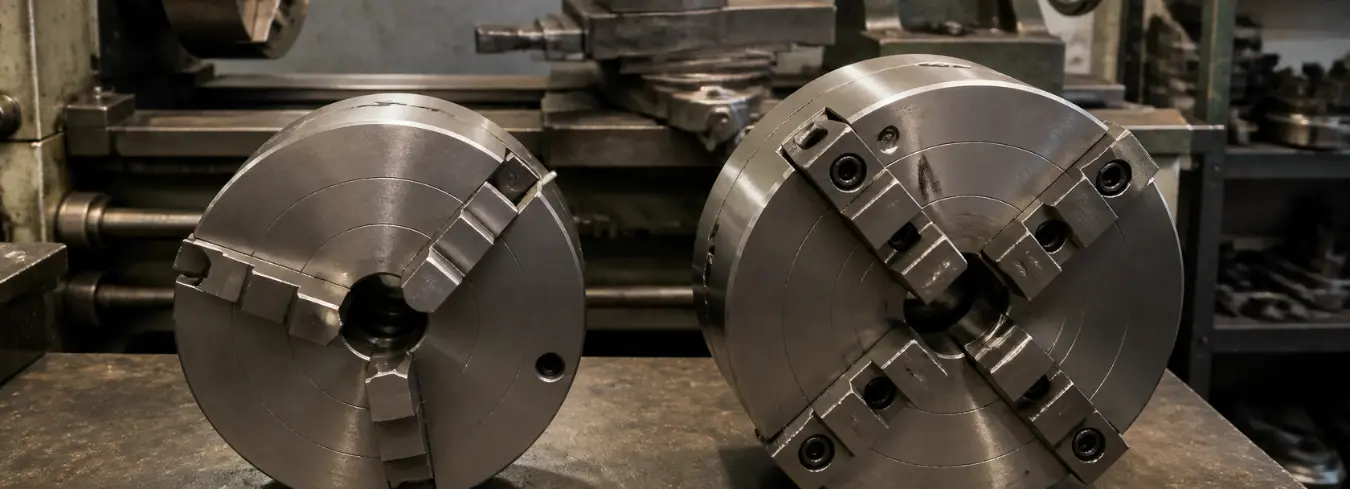
Every machinist has a preference. Most reach for the 3-jaw chuck by habit. Some swear by the 4-jaw for anything that matters. Both habits lead to problems. The wrong chuck on the wrong job costs you accuracy, rework time, and money.
The difference between these two chucks is not complicated. But understanding it properly changes how you set up jobs, what tolerances you can hold, and what equipment is worth buying for your workshop.
This guide gives you the full picture: how each chuck works, what accuracy you can realistically expect, which stock each one handles, and how to make the right choice for your operation.
At a Glance: 3-Jaw vs 4-Jaw Chuck
3-Jaw Chuck | 4-Jaw Chuck | |
Centring | Automatic (self-centring scroll) | Manual (dial indicator required) |
Setup time | Under 30 seconds | 3 to 8 minutes |
Runout | 0.05 mm to 0.15 mm | Below 0.01 mm when set correctly |
Round bar | Yes | Yes |
Hex bar | Yes | Yes |
Square / rectangular stock | No | Yes |
Irregular shapes | No | Yes |
Off-centre work | No | Yes |
Re-chucking accuracy | Inconsistent | Repeatable when re-dialled |
Best application | Production turning | Precision and toolroom work |
How the 3-Jaw Chuck Works
The 3-jaw chuck is built around a scroll plate, a flat disc with a continuous spiral groove on its face. All three jaws have teeth that mesh with this groove. When the chuck key turns the scroll, all three jaws move in or out at exactly the same rate.
This is why it is called self-centring. You do not adjust individual jaws. You close the chuck and the workpiece centres itself.
The result is a chuck that any operator can use without training, loads and unloads in seconds, and is consistent enough for the majority of standard turning work.
What it holds well:
- Round bar and tube of any diameter within the chuck range
- Hexagonal bar (three jaws contact alternate flats naturally)
- Triangular profiles
Where it falls short:
- Square, rectangular, and flat stock (the geometry does not allow even jaw contact)
- Irregular or asymmetric parts (the scroll cannot compensate for uneven shapes)
- Off-centre work (all three jaws always pull toward the same axis)
Realistic accuracy: A quality new 3-jaw chuck delivers runout between 0.05 mm and 0.10 mm. As the scroll wears with use, this figure rises. A heavily used chuck in a busy production shop can show runout above 0.25 mm without the operator realising it.
How the 4-Jaw Chuck Works
The 4-jaw chuck has no scroll plate and no self-centring mechanism. Each jaw is completely independent, driven by its own adjustment screw. To centre a workpiece, you mount it roughly by eye, then adjust opposing jaws one pair at a time while measuring runout with a dial indicator until the part runs true.
This takes longer. The payoff is accuracy that no self-centring chuck can match, and the ability to grip virtually any shape.
What it holds:
- Round bar, with greater accuracy than a 3-jaw when dialled in
- Square and rectangular bar
- Flat plate and blocks
- Asymmetric and irregular components
- Parts requiring intentional off-centre positioning (eccentric turning)
- Large rings and flanges using reversed jaws
Realistic accuracy: Below 0.01 mm with a careful setup. Skilled machinists routinely achieve below 0.005 mm total indicator reading on a rigid lathe. The accuracy comes from the operator’s setup, not the chuck mechanism. Even an older 4-jaw chuck delivers high accuracy if it is set up correctly.
The Accuracy Gap Nobody Talks About: 3-Jaw vs 4-Jaw
Most machinists know the 4-jaw is more accurate. Fewer understand exactly why, and that detail matters when you are deciding which chuck to use for a specific job.
The 3-jaw chuck centres the workpiece to the chuck’s own internal axis: the centreline of the scroll mechanism. This is not necessarily the same as the lathe spindle axis. Even when new, a 3-jaw chuck has manufacturing tolerances that create a small offset between the scroll centre and the true spindle axis.
As the scroll plate wears, this offset grows. The self-centring becomes less reliable. Parts that should run at 0.05 mm runout start showing 0.15 mm or 0.20 mm, enough to produce visible taper on a turned diameter and to affect fits and assembly.
The 4-jaw chuck is immune to this problem. You are not trusting a mechanical scroll to find centre. You are measuring directly with a calibrated dial indicator and dialling the workpiece to the spindle axis. The chuck body is just a clamping mechanism. The accuracy comes from the measurement and setup process.
This is the reason experienced machinists use the 4-jaw chuck for precision work even when the stock is perfectly round.
When the 3-Jaw Chuck Is the Right Choice
1. Production turning of round and hex bar
This is where the 3-jaw earns its place. Loading and unloading in seconds, consistent enough for standard tolerance work, usable by any operator. For shafts, pins, bushings, threaded studs, and flanges from round bar, the 3-jaw is faster and practical.
2. Facing and parting operations
Facing the end of a bar or cutting a workpiece to length does not require tight concentricity. The 3-jaw handles this without any setup time.
3. Centre drilling and through-hole drilling
When drilling on the lathe axis, the 3-jaw holds the stock securely. Small variations in runout have minimal effect on drilled hole position for standard tolerances.
4. Standard thread cutting
External metric and BSP threads on round bar fall well within the 3-jaw’s accuracy range for most fit classes and industrial applications.
5. Repetitive work on consistent stock
When every piece is the same diameter, and you are not re-chucking mid-operation, the 3-jaw delivers consistent results across the batch.
When the 4-Jaw Chuck Is the Right Choice
1. Tight concentricity tolerances
When a drawing specifies two diameters concentric within 0.01 mm or better, the 4-jaw dialled in is the only reliable method on a manual lathe. The 3-jaw cannot consistently deliver this.
2. Non-round stock
Square bar, rectangular plate, and irregular components go in the 4-jaw. For lathe machine work in UAE workshops covering fabrication, repairs, and toolroom jobs, this is an essential capability.
3. Re-chucking for secondary operations
Turn a diameter, remove the part for inspection, rechuck it to bore a concentric hole. The 3-jaw puts the part in a different position each time. The 4-jaw lets you re-dial to the same runout figure and hold concentricity between operations.
4. Eccentric and off-centre turning
Crankpins, cam lobes, and parts with intentionally offset features are positioned off the spindle axis in the 4-jaw. The independent jaws allow precise offset control.
5. Precision boring
Bearing housings, hydraulic bores, and close-fit cylindrical bores need the workpiece running as true as possible before the boring bar enters. Set the part in the 4-jaw, dial it in, and bore it. The runout at setup determines the concentricity of the finished bore.
6. Repair and salvage machining
Worn shafts, corroded flanges, and damaged components rarely have clean cylindrical surfaces for a 3-jaw to grip evenly. The 4-jaw handles them by adjusting each jaw to the available surface independently.
How to Dial In a 4-Jaw Chuck Accurately
The process looks complicated the first time. With a clear method it takes three to five minutes.
Equipment needed: A dial indicator with a magnetic base stand, positioned so the tip contacts the outer surface of the workpiece near the chuck face.
Step 1: Rough loading
Place the workpiece in the chuck and close all four jaws to finger-tight. Use your eye to get the part roughly centred. You are not aiming for precision yet, just avoiding a large starting error.
Step 2: Take the first reading
Set the indicator bezel to zero with the tip touching the workpiece. Rotate the spindle one full turn by hand. Note the highest and lowest indicator readings. The difference is your current total runout.
Step 3: Correct the first axis.
Mark the jaw at the high point. Loosen that jaw slightly, then tighten the jaw directly opposite. Move the workpiece approximately halfway to zero on this axis. Do not try to correct the full error in one step.
Step 4: Correct the second axis.
Rotate the spindle 90 degrees. Repeat the same process on the other pair of opposing jaws. Loosen the high jaw, tighten the opposite jaw, and move halfway to zero.
Step 5: Iterate
Return to the first axis and check again. Adjusting one pair of jaws shifts the other axis slightly. Each round of corrections reduces the runout further. Continue until the indicator reads less than 0.01 mm for one full spindle rotation.
Step 6: Final tighten and recheck
Tighten all four jaws firmly in the correct sequence. Recheck the indicator. If tightening moved the part, make small corrections before cutting.
With practice, most machinists achieve this in three minutes on a round workpiece.
What to Check When Buying a Lathe Chuck in the UAE
Spindle nose compatibility
This is the single most critical specification. The chuck must match your lathe’s spindle nose type exactly. Common types are camlock (D1-4, D1-5, D1-6), threaded nose, and taper key. An incorrect fitting cannot be corrected, so confirm before ordering.
Chuck diameter
Match the chuck size to the stock you turn most. A 200 mm chuck is standard for medium lathes. As a general rule, chuck diameter should not exceed the lathe’s swing over the bed.
Jaw configuration
Hard jaws are standard for gripping bar stock. Soft jaws (mild steel or aluminium inserts you bore to the workpiece diameter) can reduce 3-jaw runout to below 0.02 mm for production runs where both speed and accuracy matter.
Build quality
A precision-ground scroll plate and hardened jaws determine how long the chuck maintains its accuracy. For Vertex lathe machine accessories, including chucks, quality components are available in the UAE with spindle fittings matched to common lathe models. A quality chuck that holds 0.08 mm runout after two years of use is worth more than a cheap one that deteriorates to 0.25 mm in six months.
Soft Jaws: The Option Most Workshops Overlook
If you run production batches on round stock and need 3-jaw speed with better accuracy, soft jaws are worth understanding.
Soft jaws are replaceable mild steel or aluminium inserts fitted to the chuck in place of the standard hardened jaws. You bore them in the lathe to match the exact diameter of your workpiece. Because the bore is cut while the jaws are rotating on the spindle, the finished bore is automatically concentric with the spindle axis.
Parts loaded into correctly bored soft jaws typically run within 0.02 mm without any further adjustment. This is significantly better than the same chuck with standard hardened jaws, and with no setup time per part.
Soft jaws are bored fresh each time you change to a different workpiece diameter. They are the practical option for medium production runs where both speed and accuracy have to coexist.
Conclusion
The 3-jaw chuck and the 4-jaw chuck are not competitors. They are tools for different jobs.
The 3-jaw loads fast, centres automatically, and handles round and hex bar for standard tolerance production work. The 4-jaw takes more time to set up, accepts virtually any shape, and delivers accuracy that self-centring cannot match.
Every professional machine shop needs both. The question is not which chuck is better. It is which one is right for the job in front of you.
For Vertex lathe chucks and lathe machine tools in the UAE, visit arhtrd.com, an authorized industrial tools supplier in Dubai.
Frequently Asked Questions
Q1.Which chuck should a new workshop buy first?
Start with a quality 3-jaw chuck. It covers most everyday turning jobs without requiring dial indicator skills. Add a 4-jaw when your work demands higher accuracy or non-round stock, which it will.
Q2.Can I use a 4-jaw chuck for all production turning?
Technically yes. Practically, no. Setup time per part adds up quickly on a batch job. The 3-jaw is the right tool for repetitive turning of round and hex stock.
Q3.How do I know when my 3-jaw chuck needs replacing?
Chuck a known-good piece of round bar and check runout with a dial indicator. If it exceeds 0.20 mm on a chuck rated for 0.05 to 0.10 mm, the scroll is worn. For precision work, either replace the chuck or have the jaws reground by a specialist.
Q4.What total runout can I achieve with a 4-jaw chuck?
Below 0.01 mm is a realistic target for most setups. With care and a rigid lathe, below 0.005 mm is achievable. This is ten to thirty times better than a standard 3-jaw.
Q5.Does chuck quality affect accuracy that much?
Yes. A quality chuck maintains consistent jaw movement across its full travel, with a scroll ground to tighter tolerances. Cheap chucks have inconsistent jaw travel, poor scroll engagement, and accelerated wear. For a workshop doing any precision work, the chuck quality directly affects what you can produce.
Q6.Where can I buy lathe chucks in Dubai and the UAE?
Vertex 3-jaw and 4-jaw lathe chucks with matched spindle fittings are available through authorised lathe machine tool dealers in the UAE. Specify your lathe’s spindle nose type when enquiring.