

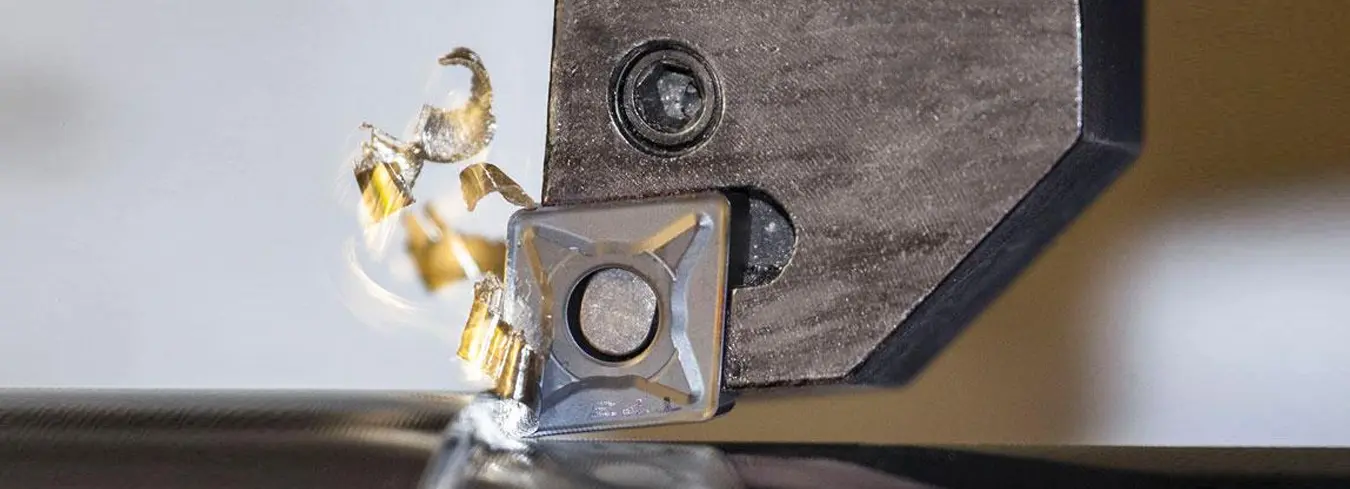
Direct Answer: To choose the right carbide insert, start with the material you are cutting. Then match the shape, grade, coating and size to your operation and tool holder. Read the ISO insert code and match the grade to the material group before you order.
A wall of inserts looks confusing until you know what each letter and grade means.
Carbide insert tools are small, replaceable cutting tips used in CNC lathes and milling machines. Each insert is made for a particular task, defined by its shape, coating and material.
Whether you are cutting steel, aluminium or tougher materials such as titanium, the right insert helps you cut cleaner and faster. This guide explains how to choose one, with six steps, an ISO code explainer and a material-group table.
Why Use Carbide Inserts?
Carbide inserts offer several practical advantages over standard HSS tools:
- Carbide inserts hold up much longer than standard HSS tools, so you replace them less often.
- Their hardness and heat resistance mean you can machine at higher speeds than with HSS tools, helping you get the job done quicker.
- The precision design gives a cleaner, smoother surface finish straight off the machine, with less need for secondary finishing.
- They may cost a bit more initially, but they save money in the long run by reducing how often you change tools.
- They are available in grades and geometries for steel, stainless steel, cast iron, aluminium and heat-resistant alloys such as titanium. Choose the right grade and geometry for each material.
Knowing the benefits is the easy part, so the next section shows how to choose well.
How to Choose the Right Carbide Insert: 6 Steps
Work through these six steps in order, and most of the choice makes itself.
1. Understand Your Application First
Know what you are cutting before you look at inserts. Is it a hard metal, a soft alloy or a combination? Different materials need different insert types.
For example, stainless steel needs an insert with high wear resistance, and aluminium needs sharp-edged inserts. Knowing the job well saves time and money.
2. Pick the Right Insert Shape and Geometry
Carbide inserts come in different shapes, and each has its purpose:
- Triangular inserts offer more cutting edges and are great for roughing.
- Diamond-shaped inserts provide precision with good finishing.
- Round inserts suit curves, and they are perfect for contouring and copy-turning because they move smoothly along the shape.
If you are not sure which shape fits your task, ask your supplier, who will know what suits your machine and material.
3. Choose the Correct Insert Grade
Some inserts last longer or perform better under pressure because of their grade. Some grades handle heat and wear well, while others are tough enough to absorb shocks without cracking. The trick is to balance hardness and toughness for the task.
- Harder grades are your best bet for high-speed cutting or a clean finish.
- Tougher grades suit interrupted cuts and roughing jobs.
4. Check the Coating Type
Coatings may seem like small details, but they make a big difference to performance and tool life:
- Titanium Nitride (TiN) is a great all-rounder, suited to everyday use and lighter machining tasks.
- Titanium Carbonitride (TiCN) is harder and more wear resistant than TiN. It suits more demanding jobs where a standard coating would wear out too quickly.
- AlTiN (Aluminium Titanium Nitride) suits high-speed machining.
Each coating helps reduce friction and heat. The right coating can be the difference between smooth running and constant tool changes.
5. Consider Insert Size and Thickness
Match the insert size to your machine’s tool holder and the type of job you are doing.
- Thicker inserts can take more heat and pressure, which makes them ideal for tough, heavy-duty jobs.
- Smaller inserts are good for precision work and tight spots.
6. Know Your Cutting Conditions
The right insert depends on how fast you are cutting, how deep you are going and how much material you are feeding through. For high-speed jobs, choose an insert that can handle heat without breaking down. For slow, heavy cuts, choose one with more toughness.
Once the basics are clear, the insert code tells you exactly what you are buying.
How to Read a Carbide Insert Code (ISO Designation)
Most inserts are named with a standard ISO code. Taking CNMG 120408 as an example, each character has a meaning:
- C is the shape: an 80° diamond. Other common shapes are T for triangle, S for square, D for a 55° diamond and R for round.
- N is the clearance angle: 0°, which makes it a negative-rake insert.
- M is the tolerance class.
- G is the hole and chip-breaker style.
- 12 is the insert size, based on the inscribed circle (12.7 mm).
- 04 is the thickness (4.76 mm).
- 08 is the nose radius (0.8 mm).
Always check the manufacturer’s catalogue for the exact meaning of each letter, and make sure the insert matches your tool holder.
Which Insert Grade Suits Which Material Group?
Insert grades are grouped by the material they machine, using the standard ISO letters.
| Group | Material | Typical choice |
|---|---|---|
| P | Steel | Wear-resistant, coated grades |
| M | Stainless steel | Tougher, coated grades with sharp, positive geometry |
| K | Cast iron | Hard, wear-resistant grades |
| N | Aluminium and non-ferrous | Sharp, uncoated or polished grades |
| S | Heat-resistant alloys and titanium | Tough grades made for heat and work hardening |
| H | Hardened steel | Very hard grades or specialised inserts |
The table gives general direction only, so check the manufacturer’s recommendation for your specific job.
Let us decode the insert for you
Send the insert code, your material and your tool holder, and we will help you choose a suitable insert.
What Should You Check Before Buying Carbide Inserts?
Three checks protect your machine, your budget and your finish before you place an order.
Check Compatibility
Always check what your CNC machine requires, because machines have specific requirements for insert types and tool holders. Double-check compatibility before buying.
Installing the wrong insert can lead to a poor surface finish, damaged workpieces or even tool breakage.
Compare Cost and Durability
A cheaper insert is not always the lower-cost choice. Inserts with a suitable grade and coating may cost more upfront. They last longer and reduce machine downtime, so the cost per part is often lower.
Judge inserts by cost per part, not by price per insert.
Do a Test Run
If you are trying a new insert or supplier, do a small test run first. This shows how the insert performs with your material and settings.
Ask your supplier whether a small quantity is available for a trial before you commit to a larger order.
With these checks done, choosing a carbide insert is straightforward, and the right insert can make the difference between smooth operation and wasted time.
Sourcing Inserts That Match Your Holder and Material
Before you contact a supplier, note the insert code, the material and the tool holder. Those three details narrow the choice quickly.
Al Rizq supplies carbide inserts in Dubai and across the UAE, including Oke carbide inserts, and cutting tools from FordMax. Send us the details and we will check what we can supply.
Bring the code, we’ll check availability
Share the code and your material, and we will tell you what we can supply.
Frequently Asked Questions
How do I choose the right insert geometry for my application?
Start with the material and the operation. Choose a shape such as triangle, diamond or round for the cut, and a geometry that suits roughing or finishing.
Which carbide insert is suitable for stainless steel?
Stainless steel is ISO group M. Choose a tougher, coated grade with a sharp, positive geometry and high wear resistance.
What does the ISO code on a carbide insert mean?
The code gives the shape, clearance angle, tolerance, hole and chip-breaker style, size, thickness and nose radius. In CNMG 120408, C is the 80° diamond shape and 08 is a 0.8 mm nose radius.
What are the types of carbide inserts?
Inserts are made for turning, milling, threading and grooving. They come in shapes such as triangle, square, diamond and round.
What is the difference between insert grades?
Grades balance hardness and toughness. Harder grades suit high-speed cutting and clean finishes, while tougher grades suit interrupted cuts and roughing.
Does Al Rizq supply carbide inserts in the UAE?
Yes. Al Rizq supplies carbide inserts in Dubai and across the UAE, including Oke carbide inserts. Send us the insert code and your material for a quote within 24 hours.