

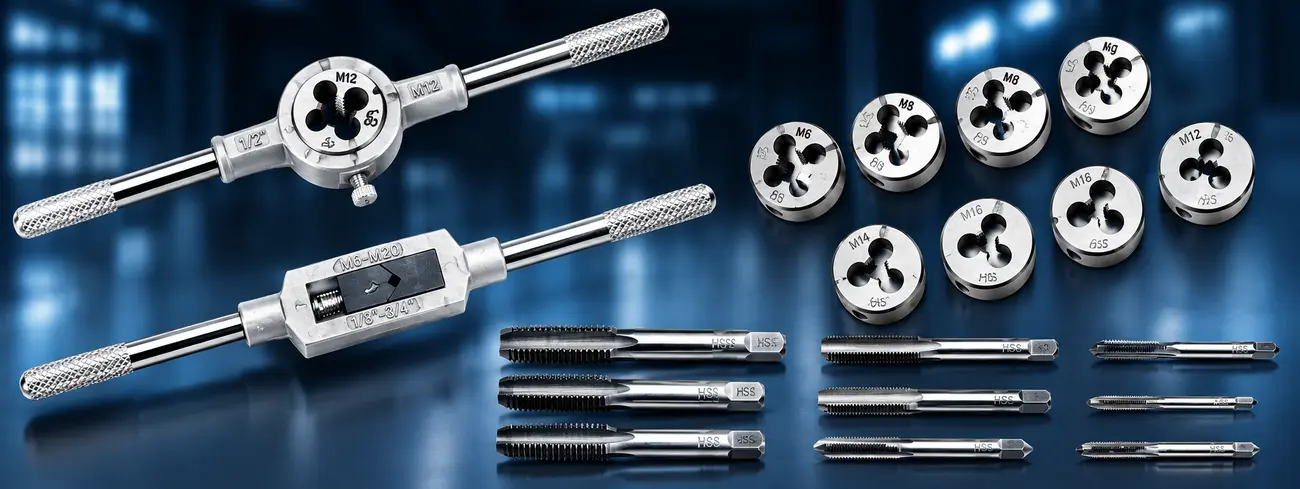
Direct Answer: A tap cuts an internal thread inside a hole, and a die cuts an external thread on a rod, bolt or pipe. Together, a tap and die let you make or repair threads by hand.
The two tools look alike, but they cut threads in opposite places.
Threading is an essential manufacturing process used in construction, plumbing and mechanical work. It makes helical grooves on metals and plastics so that bolts, screws and fasteners fit firmly.
It uses a threading tool to shape or cut threads. Taps and dies are two of the main ones, and although both create threads, they are used differently.
Ever wondered what the difference between a tap and a die is? This guide explains threading, describes both tools in detail and shows when to use each.
Tap and Die at a Glance
A tap cuts a thread inside a hole, such as the thread in a nut or a tapped hole. A die cuts a thread on the outside of a rod or bolt.
| Feature | Tap | Die |
|---|---|---|
| Cuts | Internal threads | External threads |
| Works on | A pre-drilled hole | A rod, bolt or pipe |
| Turned with | A tap wrench | A die stock (die holder) |
| Makes the thread for | A nut or tapped hole | A bolt or threaded rod |
To see why that difference matters, start with the two kinds of thread.
Internal and External Threads: Threading Basics
Threading is the process of cutting spiral grooves and threads on a cylindrical material so that screws and fasteners fit together securely. Threads are either internal or external:
- Internal threading: cuts threads within a drilled hole so that screws or bolts can be tightened.
- External threading: makes threads on the outside of a rod or pipe so that it can be screwed into a matching internal thread.
Threading is widely used in the automotive, aerospace, plumbing and construction industries. It provides structural integrity, accuracy and easy assembly.
Taps: Cutting Threads Inside a Hole
A tap is a cutting tool used for internal threading in a pre-drilled hole, so that screws or bolts can be fitted into the material. Different taps are available for different uses.
Types of taps:
- Taper tap: the cutting end has a long, gradual taper, which makes it the easiest tap to start straight. It is used first in most hand-tapping, or alone in through holes.
- Plug tap: has a moderate taper and is mainly used for general-purpose threading.
- Bottoming tap: has almost no taper and is used to cut full threads at the bottom of blind holes.
Common uses of taps:
- Cutting the internal threads of nuts, tapped holes and machine parts.
- Fixing damaged internal threads.
- Producing threads in metal, plastic and wood for commercial purposes.
High-grade taps give better accuracy, hardness and reliability in threading work.
Dies: Cutting Threads on a Rod or Bolt
A die is a tool for cutting external threads on cylindrical objects such as a rod or pipe. Die cutting is essential for producing screws, bolts and threaded rods.
Types of dies:
- Round dies: used to cut a new thread or to re-thread a damaged one.
- Hex dies (die nuts): a hexagonal die turned with a spanner or wrench, commonly used to re-cut damaged external threads.
- Adjustable dies: have a split design that lets you open or close the die slightly to adjust the fit of the thread.
Common uses of dies:
- Pipe threading and plumbing.
- Automotive and mechanical work.
- Producing specialty bolts, screws and threaded rods.
The right die gives an efficient and accurate external threading process.
Key Differences Between Taps and Dies
Taps and dies are both fundamental threading tools, but they suit different applications.
What Each Tool Cuts
- Taps establish internal threads within a pre-drilled hole, so that screws or bolts can be fitted safely.
- Dies cut external threads on cylindrical rods, pipes or bolts, so that they can be screwed into matching internally threaded holes.
Example: To attach a screw to a solid part, drill a hole and tap the internal thread. To make a bolt from a plain rod, use a die to cut the external thread.
Step by Step: Tapping vs Threading
Tapping (using a tap):
- A hole is drilled in the material.
- A tap is driven into the hole and turned to cut the thread inside.
- The tap slowly creates the internal thread, so that a bolt fits snugly.
Threading (using a die):
- A cylindrical rod or pipe is held firmly in place.
- A die is fitted over the rod and turned to cut the external thread.
- The die slowly forms the thread, so that the rod fits into a matching internally threaded hole.
Both processes need proper lubrication to reduce friction and cut smoothly.
Tap Wrench or Die Stock?
- Taps are usually turned with a tap wrench, which helps apply controlled torque during threading.
- Dies are turned with a die stock or die holder, which gives even pressure and alignment when cutting external threads.
Accurate tool selection helps avoid thread damage.
Repairing Damaged Threads
- A tap repairs damaged internal threads by re-cutting and reforming them inside a hole.
- A die repairs damaged external threads on rods, bolts or pipes and returns them to use.
Thread repair is common in plumbing, mechanical and automotive work.
Speed and Preparation Time
- Taps take more time because the hole must be drilled first and the tap must be turned carefully so it does not break.
- Dies are usually quicker because they cut the thread directly onto a rod with less preparation.
Both tools must be handled carefully to prevent misalignment and poor threads. Next, a few practical steps show how to use each one.
Taps and dies from a Volkel dealer
See our Volkel tap sets, or send us the thread size and material and we will confirm availability and quote within 24 hours.
What a Tap and Die Set Includes
A tap and die set is a kit containing a range of taps and dies in common thread sizes. It also includes the tools to turn them: a tap wrench, a die stock and usually a thread pitch gauge.
Sets are made in metric and inch sizes. Choose the thread system and sizes you need, and check the quality of the steel, because a poor set can blunt or break in use.
Cutting an Internal Thread With a Tap
Follow these steps to cut an internal thread by hand:
- Drill the hole to the correct tap-drill size for the thread.
- Secure the workpiece so it cannot move.
- Start the tap square to the hole, usually with a taper tap, applying light downward pressure.
- Turn forward about half a turn, then back about a quarter turn to break the chips, and keep going. Use cutting oil.
- Finish with a plug or bottoming tap if you need full threads in a blind hole, and clear the chips.
Cutting an External Thread With a Die
Follow these steps to cut an external thread by hand:
- Chamfer the end of the rod so the die starts easily.
- Hold the rod firmly in a vice.
- Fit the die in its stock with the start side facing the rod, and start it square.
- Turn forward a little, then back a little to clear chips, using cutting oil, until the thread is the length you need.
Choosing the Right Tap Drill Size
The drill for a tapped hole is slightly smaller than the thread’s nominal size. For a metric coarse thread, a good rule of thumb is tap drill size = thread diameter minus pitch.
For example, an M8 x 1.25 thread uses about a 6.8 mm drill, because 8 minus 1.25 is 6.75. Always check a tap-drill chart for your thread standard and material.
Tap or Die: Which Tool Should You Choose?
Taps and dies are important tools for threading and are used in manufacturing, construction, plumbing and automotive work. Taps cut internal threads in a hole that has already been drilled, while dies cut external threads onto rods, bolts and pipes.
Knowing their differences, types and uses helps you choose the right tool. High-quality threading tools and careful technique give strong, durable threads that support the reliability of mechanical parts.
Volkel Taps and Dies, and V-COIL Repair, at Al Rizq
Al Rizq is an authorised dealer of Volkel and supplies taps, dies and threading tools in Dubai and across the UAE. The range includes hand tap sets, machine taps, round dies and hexagon die nuts.
For damaged internal threads, see our V-COIL thread repair range.
Have a thread in mind?
Share the size, material and whether you are cutting inside or outside, and we will point you to the right tool.
Frequently Asked Questions
What is a tap and die?
A tap and die are threading tools. A tap cuts an internal thread inside a hole, and a die cuts an external thread on a rod, bolt or pipe.
What is the difference between a tap and a die?
A tap cuts internal threads in a pre-drilled hole and is turned with a tap wrench. A die cuts external threads on a rod and is turned with a die stock.
What are the types of taps and dies?
The main taps are taper, plug and bottoming taps. The main dies are round dies, hex dies (die nuts) and adjustable dies.
What is a tap and die set used for?
A tap and die set is used to cut new threads and repair damaged ones by hand. It includes taps, dies, a tap wrench and a die stock.
What drill size do I need to tap an M8 thread?
An M8 x 1.25 coarse thread needs about a 6.8 mm tap drill. Always check a tap-drill chart for your thread standard and material.
Can taps and dies repair damaged threads?
Yes. A tap re-cuts damaged internal threads, and a die re-cuts damaged external threads on rods, bolts and pipes.